convolve_weights#
- named_arrays.regridding.convolve_weights(weights, kernel, axis)#
Convolve the output of a set of weights with a kernel, such as a point-spread function.
If the weights computed by
weights()are the sparse matrix \(W\), this computes \(P W\), where \(P\) spreads whatever lands in each output cell over the cells around it. Applying the result withregrid_from_weights()resamples and blurs in one step, andtranspose_weights_conservative()transposes the whole operation.This is the named-axis form of
regridding.convolve_weights().- Parameters:
weights (tuple[AbstractScalar, dict[str, int], dict[str, int]]) – Weights computed by
weights().kernel (AbstractScalar) –
The kernel: the fraction of the light landing in a cell which reaches each of the cells around it. It must be dimensionless, finite, and without uncertainty.
The axes named in axis are the axes of the kernel itself. Along an axis of length \(n\), the element at index \(\lfloor n / 2 \rfloor\) is the cell the light lands in, which is where
named_arrays.convolve()andscipy.ndimage.convolve()place the center.Every other axis is broadcast by name, as in any other operation:
an axis the weights are an array over, such as a wavelength or a channel, gives a different kernel for each of its elements;
a resampled axis of the output grid gives a kernel which varies across the grid, indexed by the cell the light lands in, which is how a kernel which varies across the field is expressed;
any other axis is added to the weights and to both shapes, so the weights become a set for each of its elements.
The kernel cannot vary along a resampled axis of the input grid unless that axis is also one of the output grid, in which case it is the output grid’s axis.
axis (dict[str, str]) – A dict mapping each resampled axis of the output grid to convolve along onto the kernel axis which runs along it, such as
dict(sensor_x="kernel_x", sensor_y="kernel_y"). A resampled axis left out is not convolved along. The axes of the kernel itself have to be named differently from the axes of the grids.
- Returns:
The convolved weights, with the orthogonal axes first in both shapes, as
weights()returns them.
- Raises:
TypeError – If kernel is not a scalar without uncertainty, or axis is not a dict.
ValueError – If axis names an axis which is not a resampled output axis, or a kernel axis which the kernel lacks, which is empty, which is also an axis of the grids, or which runs along two output axes; if the kernel is not dimensionless or not finite; if it varies along a resampled input axis, or along an output axis with a different number of cells; or if its other axes cannot be broadcast against the weights.
- Return type:
Notes
The kernel acts on cells, so for a point-spread function it should be the point-spread function convolved with a cell twice, once for the cell the light lands in and once for the cell it is collected in.
A kernel held as a
FunctionArrayof the offsets of its elements can be passed as itsoutputsonly if the offsets along each axis run from \(-\lfloor n / 2 \rfloor\), so that the element at index \(\lfloor n / 2 \rfloor\) is the one at zero offset. Otherwise the result is shifted by the difference.Examples
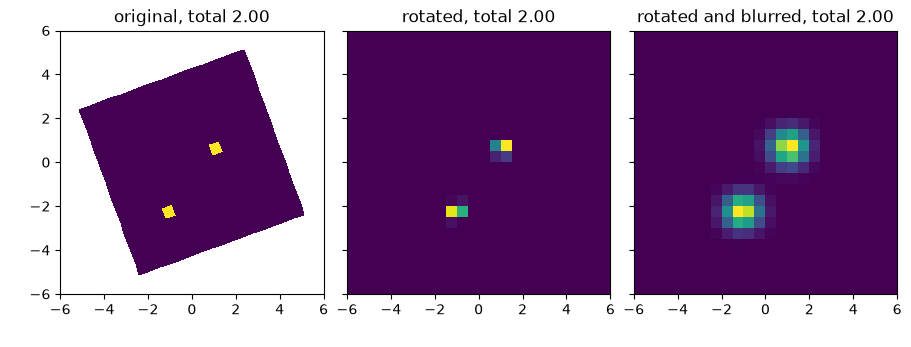
Rotate an array onto a new grid, and blur it with a Gaussian kernel in the same set of weights.
import numpy as np
import matplotlib.pyplot as plt
import astropy.units as u
import named_arrays as na

# Define a grid of vertices, and rotate it
coordinates_input = na.Cartesian2dVectorLinearSpace(
    start=-4,
    stop=4,
    axis=na.Cartesian2dVectorArray("x", "y"),
    num=17,
).explicit
coordinates_input = na.Cartesian2dRotationMatrixArray(20 * u.deg) @ coordinates_input

# Define a uniform output grid
coordinates_output = na.Cartesian2dVectorLinearSpace(
    start=-6,
    stop=6,
    axis=na.Cartesian2dVectorArray("x_new", "y_new"),
    num=25,
)

# Define an array of values with two bright cells
values_input = na.ScalarArray.zeros(dict(x=16, y=16))
values_input[dict(x=4, y=4)] = 1
values_input[dict(x=10, y=8)] = 1

# Save the weights which rotate the input array onto the output grid
weights = na.regridding.weights(
    coordinates_input=coordinates_input,
    coordinates_output=coordinates_output,
    method="conservative",
)

# Define a Gaussian kernel, five cells across
offset_x = na.arange(-2, 3, axis="kernel_x")
offset_y = na.arange(-2, 3, axis="kernel_y")
kernel = np.exp(-(np.square(offset_x) + np.square(offset_y)) / 2)
kernel = kernel / kernel.sum()

# Blur the output of the weights with the kernel
weights_blurred = na.regridding.convolve_weights(
    weights=weights,
    kernel=kernel,
    axis=dict(x_new="kernel_x", y_new="kernel_y"),
)

# Apply both sets of weights
values_rotated = na.regridding.regrid_from_weights(
    *weights,
    values_input=values_input,
)
values_blurred = na.regridding.regrid_from_weights(
    *weights_blurred,
    values_input=values_input,
)

# Plot the original, rotated, and blurred arrays
fig, ax = plt.subplots(
    ncols=3,
    sharex=True,
    sharey=True,
    figsize=(9, 3.4),
    constrained_layout=True,
)
na.plt.pcolormesh(coordinates_input, C=values_input, ax=ax[0])
na.plt.pcolormesh(coordinates_output, C=values_rotated, ax=ax[1])
na.plt.pcolormesh(coordinates_output, C=values_blurred, ax=ax[2])
ax[0].set_title(f"original, total {values_input.sum().ndarray:.2f}")
ax[1].set_title(f"rotated, total {values_rotated.sum().ndarray:.2f}")
ax[2].set_title(f"rotated and blurred, total {values_blurred.sum().ndarray:.2f}")
for a in ax:
    a.set_aspect("equal")